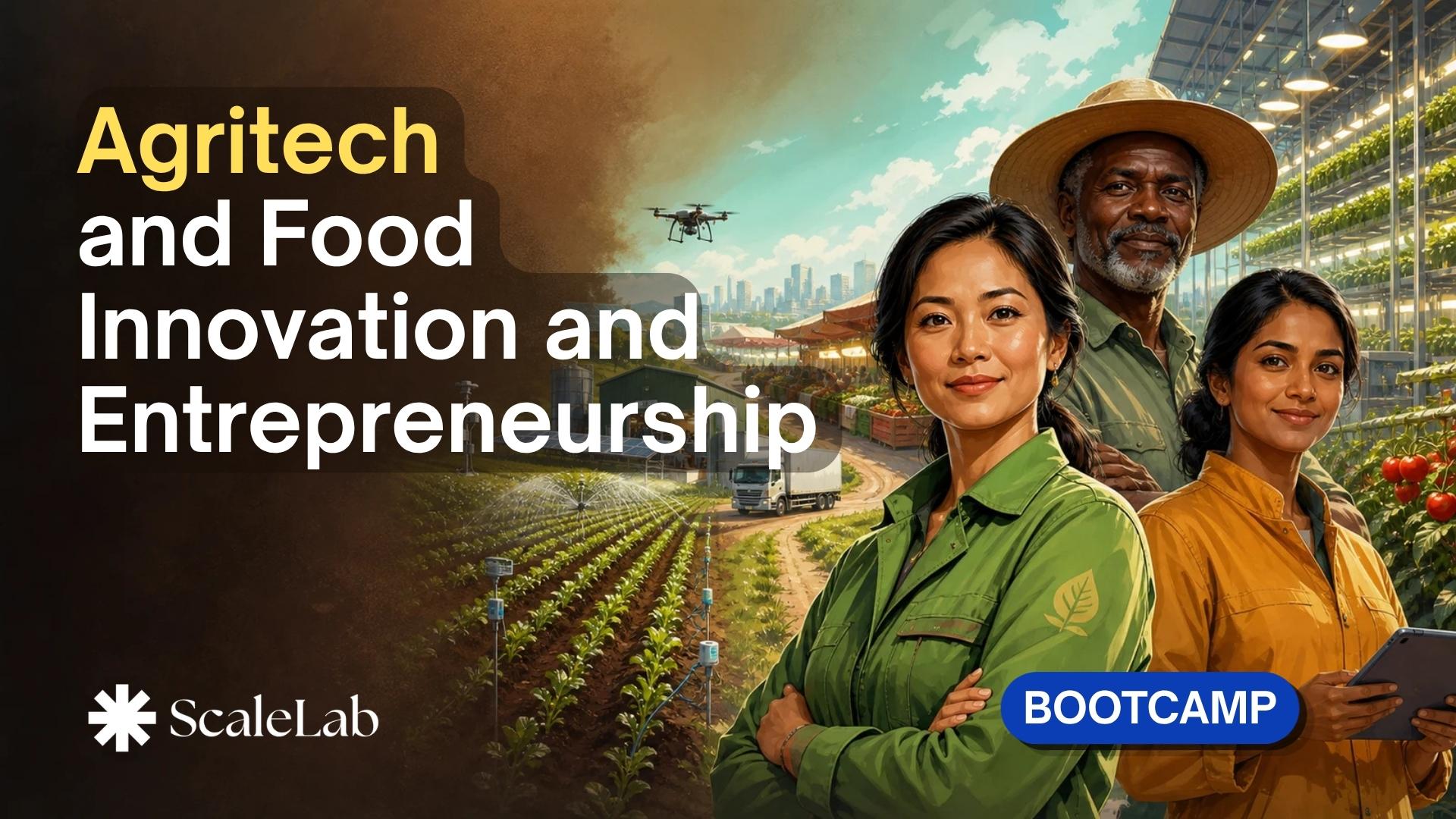
Agritech and Food Innovation and Entrepreneurship Masterclass

Wishlist Share
$20.99
Enrollment is now paused

About Course

Agriculture and food are full of urgent problems—rising costs, farm risk, waste, weak supply chains, food-safety pressure and changing customer expectations. Yet promising ideas often remain classroom concepts because founders do not spend enough time with farmers, processors, distributors, retailers or consumers. This course takes learners into the real farm-to-fork system and helps them turn a verified problem into a practical and commercially credible enterprise.

You will investigate stakeholders, size the market, design the value proposition, select appropriate technology and build a viable business and brand. You will then create and test an MVP, map food safety and regulation, protect intellectual property, design sourcing and operations, and prepare a focused go-to-market system. Every section produces a portfolio asset, from the venture thesis and customer evidence to the prototype, operating plan, financial model and first-customer pipeline.

By the end, you will become an agritech or food-innovation entrepreneur with a visible enterprise—not merely a business idea. Your final portfolio will include a public landing page, tested MVP, customer evidence, business and brand, regulatory pathway, operating plan, go-to-market system, financial snapshot, global funding pipeline, pitch deck and 90-day launch roadmap. Successful learners receive a Scalelab Academy certificate, lifetime course access, future updates and course-specific AI tools for research, interviews, market sizing, operations, financial modelling, funding discovery and pitch preparation.

Show More

What Will You Learn?

  • Choose a focused opportunity and write an agrifood venture thesis.
  • Validate a meaningful problem through stakeholder evidence.
  • Map customers, beneficiaries, buyers, regulators and partners.
  • Analyse competitors and estimate TAM, SAM and SOM.
  • Design a feasible solution and compelling value proposition.
  • Select appropriate technologies and innovation partners.
  • Build a viable revenue model, brand and market position.
  • Create and demonstrate a minimum viable product.
  • Test demand, usability, feasibility and willingness to pay.
  • Build a regulatory, food-safety, IP and enterprise-risk roadmap.
  • Design sourcing, production, quality, logistics and partnerships.
  • Create a pilot offer, go-to-market plan and first-customer pipeline.
  • Develop unit economics and a global funding and accelerator pipeline.
  • Launch a public enterprise presence, pitch deck and 90-day roadmap.

Course Content

Section 1: Explore Agritech and Choose Your Opportunity
Section goal and target content. Understand the farm-to-fork value chain, urgent industry challenges, emerging technologies and viable venture models. Learners will choose an opportunity aligned with their experience, resources and intended market.

  • Map the farm-to-fork value chain
  • Explore agritech and foodtech opportunity areas
  • Identify industry shifts and unmet needs
  • Compare product, platform and service ventures
  • Match founder strengths to sector opportunities
  • Write the initial agrifood venture thesis

Section 2: Discover an Agrifood Problem Worth Solving
Section goal and target content. Investigate real operational, financial, environmental and customer problems experienced by farmers, processors, distributors, retailers and consumers. Learners will replace assumptions with field evidence.

Section 3: Understand Customers and Agrifood Stakeholders
Section goal and target content. Separate users, customers, beneficiaries, buyers, regulators and partners. Learners will map their needs, incentives, resources, adoption constraints and influence over purchasing decisions.

Section 4: Research the Market and Size the Opportunity
Section goal and target content. Analyse market structure, competitors, substitutes, trends, seasonality and adoption barriers. Learners will estimate the reachable opportunity and select a focused beachhead market.

Section 5: Design the Solution and Value Proposition
Section goal and target content. Translate the validated problem into a clear, feasible solution. Learners will define intended users, use cases, essential features and the measurable economic, operational or consumer value delivered.

Section 6: Select the Technology and Innovation Model
Section goal and target content. Evaluate technology according to the problem it solves rather than novelty. Learners will compare digital, biological and physical options and decide what to build, buy, integrate, license or access through partners.

Section 7: Build the Business and Revenue Model
Section goal and target content. Design how the venture creates, delivers and captures value across the agrifood system. Learners will test revenue, pricing, costs, channels, partnerships and defensibility using sector-appropriate patterns.

Section 8: Build the Agrifood Brand and Market Position
Section goal and target content. Create a credible name, position, message and public promise for the venture. Learners will translate technical or operational value into language that customers, partners and funders can understand.

Section 9: Build the Minimum Viable Product
Section goal and target content. Create a visible prototype, pilot product, service demonstration or platform mock-up. Learners will define what the MVP must prove and build the smallest responsible version that can generate evidence.

Section 10: Test the MVP and Prove Demand
Section goal and target content. Test the venture with intended users, buyers and partners. Learners will measure usability, adoption, willingness to pay and operational feasibility, then improve the solution using evidence.

Section 11: Navigate Regulation, Risk and Responsible Enterprise
Section goal and target content. Map the requirements and risks that could determine whether the venture can launch. Learners will address food safety, agriculture, environment, data, certification, intellectual property, inclusion and credible sustainability claims.

Section 12: Design Operations and Strategic Partnerships
Section goal and target content. Turn the venture into a dependable operating system. Learners will plan sourcing, production, quality, storage, logistics, traceability, staffing and the partnerships needed to deliver consistently.

Section 13: Win Customers and Launch the Go-to-Market System
Section goal and target content. Build early demand through focused pilots, sales and partnerships. Learners will prepare sector-specific offers and create a realistic system for winning the first customers without relying on broad promotional activity.

Section 14: Finance, Fund and Launch the Agrifood Enterprise
Section goal and target content. Connect unit economics, working capital and growth milestones to suitable capital and support. Learners will build a global pipeline of grants, impact investors, agrifood funds, corporate programmes, incubators and accelerators, then launch the venture publicly.

Student Ratings & Reviews

No Review Yet
No Review Yet

Want to receive push notifications for all major on-site activities?